
Angkor Wat was always on my Southeast Asia itinerary. I had seen hundreds of Google images—the dark outline of the towers at sunrise, the reflection in the water, the perfect symmetry that makes you wonder if it is AI generated or well edited.
But nothing prepared me for that 5 AM moment.
The photographs show Angkor Wat’s beauty, but never its scale. YouTube and Instagram can tell you endless stories about its Hindu and Buddhist connections, but nothing prepares you for the familiarity that hits when you stand there in person. I kept hearing names and stories I had known since childhood—Vishnu, Shiva and Brahma; the Ramayana and the Mahabharata; lingas, nagas, flower offerings and incense. And then there was the temple itself, designed as Mount Meru, rising from the Cambodian landscape.
In that moment, it felt as though the stories had crossed the sea long before me, learnt another language and decided to live inside Cambodian stone.

Look up Vs Walk with me
My mind naturally started to reach for familiar anchors, I found myself comparing every temple I know in India.
I thought of Brihadeeswarar in Thanjavur, that granite vimana rising directly above the sanctum, solid, vertical and commanding. I thought of Hoysala and Vijayanagar pillars and sandstone carvings flowing with narratives.
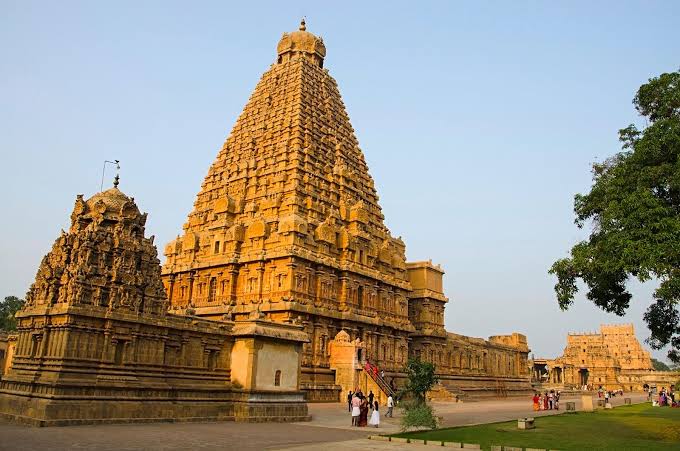


But Angkor Wat was different. It didn’t simply point upward like Mount Meru; it made me walk.
I crossed the moat, took the long sandstone causeway, entered the galleries and moved through a sequence of courtyards and enclosures before I reached the central towers. The temple is not simply a structure; it is an experience designed step by step. The galleries were where the story lived. The ascent through three levels—public, governors, king—was the entire experience of understanding a civilization.
King Suryavarman II built this between 1116 and 1145. A little over a century after Rajaraja Chola completed Brihadeeswarar. Both temples were built by ambitious kings who wanted to place their kingdom close to the gods. But two totally different visions of how stone should speak even long after they were gone.
The Chola king made granite rise toward the sky—hard, heavy, stubborn stone carrying the weight of heaven itself. Look up, it commands.
The Khmer king made sandstone flow—soft, precise, carved from Kulen. Gods and demons and armies do not sit quietly. They move through the galleries. Walk with me, it says.
Angkor Wat is not an Indian Hindu temple standing tall in Cambodia. It is a Khmer masterpiece that may have had a long conversation with India. That is totally different.
When Myths become conversations….
Standing before the Churning of the Ocean of Milk carved across an entire Angkor Wat wall, I felt vertigo.
That’s a story from my childhood in every temple, in paintings, in my grandmother’s voice. But here, carved on a scale I’d never imagined, the devas and asuras were pulling Vasuki while Vishnu holds the cosmos steady.


The epics had crossed the sea—the Ramayana, the Mahabharata—and with them, the mythological animals travelled too, not in Noah’s ark, but as stories woven into memory.
In Indian mythology, every animal carries meaning. The lion represents ferocity and protection, the elephant embodies strength and wisdom, and the serpent holds primordial power. We carved them into temples everywhere because they represented something sacred, something that needed to be seen and remembered.
In Cambodia, the lions roared fiercely at every gate, similar to the yalis in South Indian temples. My guide spoke about the majestic and ceremonial Airavata, the elephant of Indra, king of the Devas. What is interesting is the stories travel but the imagination is theirs, so you can see the difference in how it is depicted on stones.


But the naga showed me something deeper. In Indian mythology, the naga is Adisesha—the primordial serpent, the cosmic foundation. We know it beneath Vishnu, above Shiva lingas, sacred, but contained. A guardian in defined spaces.
In Cambodia, the naga became architecture. At Angkor Thom, I walked across a bridge where the naga’s body was the balustrade. Its heads guarded the gateway. At every shrine, Buddha sits sheltered beneath the spread hood of Mucalinda the naga king during a storm.
In India, we remember Buddha beneath the Bodhi tree, the moment of awakening. In Cambodia, after enlightenment, during a terrible storm, Mucalinda the naga king rises to protect the meditating Buddha.
It is the same mythology but completely different imagination. That’s how stories live. Not as replicas passing from one place to another. As living conversations between civilisations, each speaking the same language in their own voice.
How Stories Travelled through The Bay of Bengal
But how did these stories arrive in Cambodia in the first place? For centuries, maritime traders—the Cholas among them—connected South India with Southeast Asia. Their ships, along with merchants from multiple regions, carried stories and goods and spiritual ideas across the Bay of Bengal. A merchant carried cloth and returned with an idea. A priest travelled with a manuscript. A ruler adopted a sacred concept and transformed it into power.
Buddhist missionaries travelled. Hindu priests travelled. Srivijaya traders travelled. Ideas and Skills moved through trade routes, pilgrimage routes, and cultural exchanges—not just one civilization dominating, but many voices learning from each other .
No single Indian kingdom conquered Cambodia. No single empire built Angkor Wat. But the stories and Skills travelled -Knowledge transferred across centuries, through many peoples and many journeys.
Bayon: The Temple That Watches You
After Angkor Wat, I walked toward Bayon expecting another grand statement. What I found instead was something strange and more beautiful.
Fifty-four towers. On each tower, four enormous faces, one looking in each direction, similar to the four-headed Brahma, the creator. Some say they’re Avalokiteshvara, the Bodhisattva of compassion. Others connect them with King Jayavarman VII himself. Whoever they represent, they’re watching. Not in a frightening way, but there’s a serenity in those stone faces that I couldn’t quite explain.
Bayon is not a building. It’s a presence. An entire temple built around the idea of attention, watching, witnessing, holding space. In the morning light, those faces looked almost alive.

A guide told me that Jayavarman VII built this after a period of religious conflict. He was trying to create something that held multiple truths, Hindu and Buddhist, old and new —all at once.
Ta Prohm: Where Forest and Stone Became One
Ta Prohm did something to me that no other temple had done, it made me stop believing in the distinction between destruction and preservation, between time moving forward and time standing still.
The roots of giant trees wrap around walls, doors, and stones in a way that feels less like invasion and more like an embrace. Walking through the galleries, I kept asking myself the same question: is the forest destroying this temple or holding it together? And the longer I walked, the more I realized the answer didn’t matter. Maybe survival sometimes means learning to live with what’s trying to consume you.


I mentioned to my guide that this is the spot where Lara Croft’s Tomb Raider, movie was shot. He didn’t smile nor liked the comparison. He told me instead that King Jayavarman VII built this temple in haste, rushing to prove his power and his worth, unlike the meticulous decades spent crafting Angkor Wat. As if to say: this isn’t a movie set for tourists. This is a story of urgency, of a king trying to leave his mark quickly, before time could take it from him.
Of all Cambodia’s temples, this one felt most alive because it wasn’t finished, because it was still becoming. The roots that wrapped around the stones held more than architecture—they held the story of survival, of a civilization learning to endure not by resisting chaos, but by surrendering to it and finding strength in that surrender.
Kulen Mountains: The Rocks became sculptures
Phnom Kulen is where a mountain transformed raw sandstone to stone blocks. Those blocks travelled through water and land and became galleries and towers. The building blocks of Angkor Wat started from this mountain which became a civilization’s identity.


At Kbal Spean, the river is the sanctum. Hundreds of lingas and yonis are carved into the riverbed. Water flows over them and continues downstream. There are carvings of Vishnu reclining on Ananta, Lakshmi beside him, Brahma emerging from the lotus growing from Vishnu’s navel. The carvings on the river bed, That was one of the most beautiful ideas I carried home from Cambodia.
The People Who Keep the Stories Alive
What struck me most about Cambodia was the gentleness of the people. Given what they’d endured—the Khmer Rouge, civil war, unimaginable loss—I expected hardness. Instead, I found warmth.
I felt this same gentleness in Sri Lanka too. The same patient kindness despite everything they’d carried. And I wondered: does surviving the worst teach you to treasure small moments? Maybe hardship doesn’t harden people the way we think. Maybe it teaches them that kindness isn’t a luxury—it’s how you survive. It’s how you rebuild.
My guide, Chunn, was proof of this. He carried stories of his father who fought during the Khmer Rouge years. He spoke about those years not with bitterness, but with patient sadness. “Many people died,” he’d say, standing before the temples. “But we are still here. And Angkor reminds us why.”
Yet in the next breath, he’d laugh. He’d make a joke. He’d drive us through Siem Reap in his tuk tuk with infectious energy, narrating our trip with enthusiasm. He carried the weight and the joy simultaneously—not as contradiction, but as survival.
I had spent my entire trip comparing. Indian temples to Cambodian ones. Granite vimanas to sandstone galleries. Adisesha to Mucalinda. But that was a dangerous trap. What I should have been seeing all along was adaptation. The stories didn’t travel unchanged. They became Cambodian. They acquired new meanings, new forms, new urgency. They became conversations between civilisations.
This is what I finally understood: heritage doesn’t stay alive through museums or international organizations or perfect preservation. It stays alive through people. Through Chunn driving tourists and telling his father’s story. Through monks still worshipping in temples reclaimed by forests. Through families carrying flowers to shrines. Through the daily, ordinary, joyful act of tending to what came before.
Stories do not belong to where they began. They belong to people brave enough to live inside them—carrying the grief, the history, the weight, AND the laughter, day after day, year after year, so that they never become monuments. They remain alive.

Note for Indian vegetarian travellers:
We stayed at Pangolin Villas for three days and it was the perfect base to return to after long temple days—beautiful, peaceful, and well-located. For vegetarian travellers, Pub Street has many options and local Cambodian(Khmer) cuisine is surprisingly accommodating, but be cautious about oyster sauce as it hides in many dishes. One thing we discovered and perfected: order the stir-fried morning glory with garlic. It became our go-to dish, and once you find it, you’ll order it again and again. Perfect villa, perfect food.


